

Nvidia extended its massive rally for a seventh consecutive session as investors continued pouring into artificial intelligence-related stocks, pushing the chipmaker closer to an unprecedented $6 trillion market valuation.
The stock climbed another 4.4 % to $235.74 on Thursday, capping a roughly 20% surge over the past seven trading days. The move added more than $900 billion to Nvidia's market capitalization, further cementing its dominance at the center of the global AI investment boom.
The rally reflects intensifying investor appetite for companies seen as direct beneficiaries of the artificial intelligence arms race, particularly semiconductor firms supplying the infrastructure behind large-scale AI models and data centers.
Investor optimism also strengthened after Nvidia Chief Executive Officer Jensen Huang joined President Donald Trump during his trip to China this week, fueling speculation that stalled negotiations surrounding Nvidia's H200 AI chip sales to China could eventually move forward.
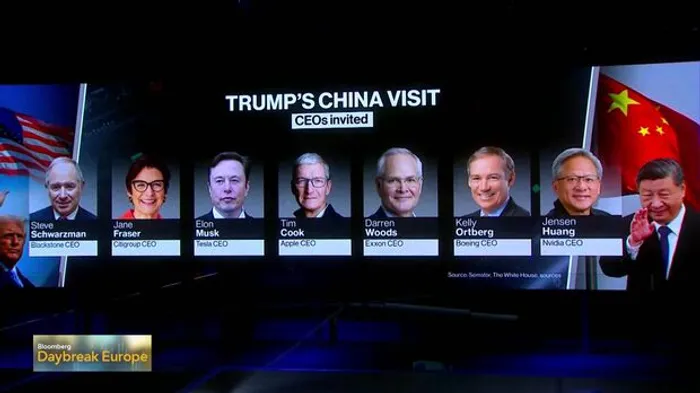
The United States recently approved around 10 Chinese companies to purchase Nvidia's H200 processors, including major technology firms such as Alibaba, Tencent, ByteDance, and JD.com. Approved distributors reportedly include Lenovo and Foxconn, with each customer permitted to purchase up to 75,000 H200 chips under U.S. licensing terms.
However, despite Washington's approval, no shipments have been delivered so far, highlighting the increasingly complex technology rivalry between the United States and China.
Chinese firms reportedly slowed purchases after receiving guidance from Beijing, as Chinese policymakers continue pushing domestic companies to reduce reliance on American semiconductor technology. Concerns have also intensified after China introduced new supply chain security regulations aimed at reducing foreign dependence in critical technology infrastructure.
The standoff leaves Nvidia caught between the competing strategic priorities of the world's two largest economies.
Before tighter export restrictions were introduced, Nvidia controlled roughly 95% of China's advanced AI chip market. China previously accounted for approximately 13% of Nvidia's total revenue, while Huang has estimated China's AI market alone could reach $50 billion this year.
At the same time, Washington continues tightening safeguards surrounding advanced AI exports. Under current U.S. rules, Chinese buyers must prove the chips will not be used for military purposes and must demonstrate sufficient security protections before purchases can proceed.
President Trump also reportedly negotiated a framework under which the United States would receive 25% of the revenue generated from approved chip sales to China. The arrangement requires chips to pass through U.S. territory before final shipment, though the structure has reportedly raised concerns within Beijing over potential security vulnerabilities.
Despite the geopolitical uncertainty, Wall Street continues focusing heavily on Nvidia's explosive growth trajectory and the broader acceleration in AI spending.
The Philadelphia Semiconductor Index has surged nearly 70% since late March, while other chipmakers including Intel, Micron Technology, Advanced Micro Devices, and Broadcom have also posted sizable gains as investors aggressively rotate into AI infrastructure plays.
Meanwhile, analysts continue raising expectations for Nvidia's financial performance. UBS now expects Nvidia to generate approximately $81 billion in first-quarter revenue, roughly $3 billion above prior guidance. The bank also projects second-quarter revenue guidance between $90 billion and $91 billion, reinforcing expectations that hyperscaler AI spending remains exceptionally strong.
UBS additionally highlighted shareholder returns as another potential catalyst, with investors increasingly anticipating a massive buyback authorization that could reportedly approach $150 billion over the next 12 months, alongside a possible dividend increase.
Still, Nvidia's extraordinary rally has also fueled growing concerns that the broader stock market is becoming increasingly dependent on the AI trade. Nvidia and Micron alone have reportedly accounted for more than 30% of the S&P 500's gains this year, intensifying fears in some corners of Wall Street that an AI-driven bubble could eventually face a sharp correction.