

Artificial-intelligence chip startup Cerebras Systems priced its highly anticipated IPO at $185 per share on Wednesday, well above its already raised target range, giving the company a fully diluted valuation of roughly $56.4 billion ahead of its Nasdaq debut under ticker "CBRS" on Thursday.
The offering raised approximately $5.55 billion after Cerebras sold 30 million shares, with underwriters holding the option to purchase an additional 4.5 million shares.
Investor demand accelerated rapidly during the roadshow. Cerebras initially targeted a range of $115–$125 per share before raising it to $150–$160, ultimately pricing far above expectations as enthusiasm around AI infrastructure and inference computing continued to surge.
Founded in 2016 in Silicon Valley, Cerebras has positioned itself as one of the few serious challengers to Nvidia in the AI hardware race. Unlike traditional GPU architectures, Cerebras uses a wafer-scale design that turns an entire silicon wafer into a single massive chip. Its latest Wafer Scale Engine 3 is roughly 58 times larger than Nvidia's Blackwell B200 chip and is optimized for inference — the increasingly critical process of running AI models after training.
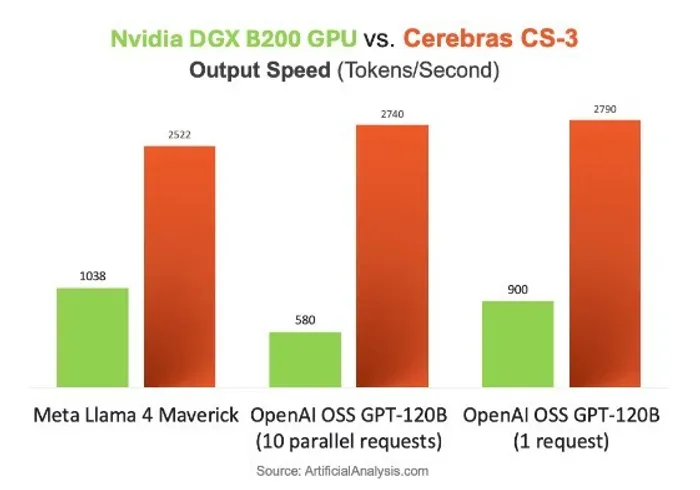
The company argues its architecture delivers significantly faster speeds and lower costs for inference workloads, particularly as AI applications shift toward agentic AI and real-time reasoning systems.
Cerebras has also secured major strategic partnerships. In January, the company signed a multiyear agreement worth more than $20 billion with OpenAI to deploy 750 megawatts of AI compute capacity. The two companies are also expected to co-design future AI models optimized for Cerebras hardware.
The relationship between Cerebras and OpenAI stretches back much further. According to testimony revealed during Elon Musk's lawsuit against OpenAI, the AI company explored a potential merger with Cerebras in 2017 as part of its pursuit of artificial general intelligence, or AGI.
"Exclusive access to Cerebras hardware would give OpenAI an overwhelming hardware advantage over Google," OpenAI co-founder and president Greg Brockman wrote in an internal email disclosed during the case.
Court filings also showed Brockman owned roughly 78,000 shares of Cerebras at the end of 2025, a stake now worth around $14.4 million at the IPO price. Sam Altman reportedly held about 89,000 shares, valued at approximately $16.5 million based on the IPO pricing.
In March, Cerebras entered a partnership with Amazon Web Services to deploy its CS-3 systems inside AWS data centers, further strengthening its position in the cloud AI race.
Financially, Cerebras posted strong growth momentum heading into the IPO. The company reported 2025 revenue of $510 million, up from $290.3 million a year earlier, while swinging to net income of $87.9 million from a prior-year loss of $484.8 million.
Still, the company's valuation remains aggressive at more than 100 times annual revenue, underscoring how heavily investors are betting on the next phase of the AI infrastructure boom — especially demand beyond Nvidia.
Cerebras previously faced scrutiny after its earlier IPO attempt in 2024 stalled due to concerns over customer concentration tied to UAE-based G42. In its updated filing, Cerebras disclosed that G42 accounted for 24% of revenue last year, down sharply from 85% previously, though another UAE-linked institution still represented a large portion of sales.
Bloomberg also reported this week that both Arm Holdings and SoftBank Group explored acquiring Cerebras ahead of the IPO.
The listing is now widely viewed as a major test for whether public markets are still willing to aggressively fund the AI trade beyond Nvidia — especially in the rapidly expanding inference segment.