

Crude oil surged on Sunday at the expense of equities after the United States announced a blockade of Iranian ports, escalating tensions following the collapse of high-stakes negotiations with Tehran and putting a fragile ceasefire at risk.
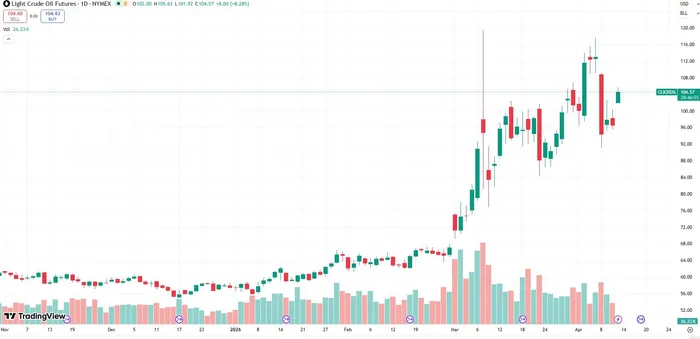
U.S. crude oil futures for May delivery jumped 8% to above $104 per barrel as fears of supply disruptions intensified, while Nasdaq 100 futures dropped 1% after the failed peace talks.
U.S. Central Command said the blockade will take effect Monday at 10 a.m. ET, targeting all maritime traffic entering and exiting Iranian ports. The measure will be applied broadly across vessels of all nations operating in Iranian coastal areas, including ports along the Arabian Gulf and Gulf of Oman. However, U.S. forces emphasized that freedom of navigation will remain intact for ships transiting to and from non-Iranian ports through the Strait of Hormuz.
"The blockade will be enforced impartially against vessels of all nations entering or departing Iranian ports and coastal areas," CENTCOM said in a statement.
The decision followed the failure of U.S.-Iran talks in Pakistan, which had aimed to end weeks of conflict. Despite a temporary ceasefire agreed earlier in the week, negotiations broke down over key issues, including Iran's nuclear program and control of the Strait of Hormuz.
President Donald Trump had warned earlier on Sunday that the U.S. Navy would take aggressive action in the region.
"Effective immediately, the United States Navy… will begin the process of BLOCKADING any and all ships trying to enter, or leave, the Strait of Hormuz," Trump said in a social media post.
He added that any vessel paying tolls to Iran for passage would be targeted, stating, "No one who pays an illegal toll will have safe passage on the high seas."
Trump also signaled potential military escalation, with reports indicating he is considering limited strikes to break the diplomatic deadlock. He further warned that U.S. forces would move to clear naval mines allegedly deployed by Iran in the strait, a key global energy chokepoint responsible for roughly 20% of the world's oil supply.
Iran responded with strong warnings of its own. The Revolutionary Guards said any military vessels approaching the Strait could be treated as a violation of the ceasefire and would face a decisive response. Iranian officials also pushed back on U.S. demands, with parliamentary speaker Mohammad-Bagher Ghalibaf stating that Washington had failed to gain Tehran's trust during negotiations.
"If you fight, we will fight, and if you come forward with logic, we will deal with logic," he said.
Foreign Minister Abbas Araqchi criticized the U.S. approach, accusing Washington of "maximalism" and shifting demands during talks that were close to producing an agreement.
Vice President JD Vance, who led the U.S. delegation, said the talks ultimately failed because Iran would not commit to abandoning nuclear weapons ambitions. "We have not seen that yet," he said, referring to a clear assurance from Tehran.
The Strait of Hormuz remains under tight control, with tanker traffic still far below pre-conflict levels. Before the war, more than 100 vessels passed through the strait daily, compared with only a handful in recent days.
Although a few fully loaded supertankers have resumed transit following the ceasefire, the situation remains fragile. Iran has indicated that safe passage is conditional and continues to assert control over the strategic waterway, with officials emphasizing that the "key to the Strait of Hormuz" remains in its hands.
Despite the escalation, both sides have left the door open for further negotiations. Trump said he still believes Iran could return to the table, describing recent discussions as "very friendly," while Iranian leaders signaled willingness to continue talks under what they described as a more balanced framework.